


Lessons Learned at FWCD, in College and Beyond
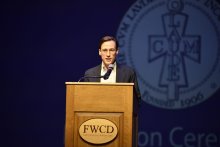
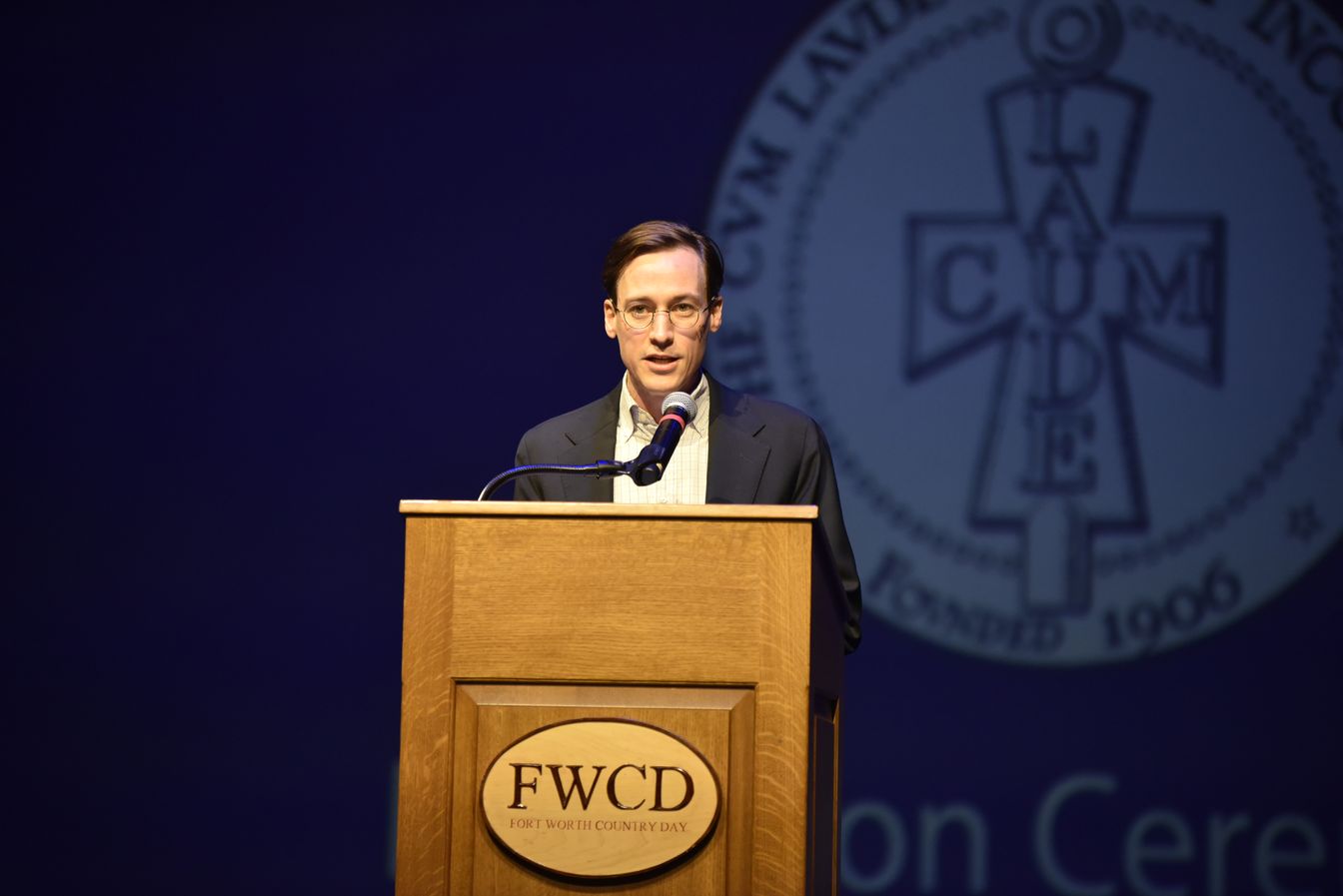
Ed Landreth ’03 was the keynote speaker at this year’s Cum Laude Induction. He shared an important message with students, emphasizing the value of hard work, flexibility, and creating your own definition of success. Landreth opened with a piece of advice he received from his supervisor when working as a first-year Analyst at JPMorgan after college: “Nail the job you have right now.” He elaborated, sharing that even if you’re in a class you don’t like or hoping for something different down the line, focusing on doing great work now, showing up on time, and giving your best effort will open doors in the future. The people around you will notice the effort, which shows character and integrity.
His next takeaway was to remember that there is no perfect path, as long as you choose something and commit long enough to learn from it. In the same vein, Landreth stressed that it’s also ok to change your path. He reminded students that he started as a finance major, worked for a bank for six years, and, while there, began volunteering on weekends, discovering his passion for service. Though it seemed risky to some, he took the leap to transition to a new career out of a desire to serve. Although it would mean a change in title and salary, he felt called to pursue this new path and was supported by those he had worked with in the past. Following a three-month internship in Bolivia, Landreth attended Johns Hopkins University, where he earned a Master of Arts in International Development. He then began work with USAID, where his projects steered activities toward peace and reconciliation in Côte d’Ivoire after years of unrest, trained and educated small farmers in Nigeria to increase crop yields, and improved the reading levels of elementary students in the Democratic Republic of the Congo through the distribution of textbooks and teaching guides.
Landreth noted that after 13 years of Spanish at FWCD, his work now required him to learn French quickly to communicate effectively with his new colleagues and partners, leading to his next takeaway: “Sometimes you choose change, but sometimes change finds you, and you have to adapt.” While he’d chosen this career transition, it was important for him to adapt and find ways to apply the skills he gained in finance to this new realm, while learning other skills for success. He shared his talents in budgeting and creating programmatic structures while learning new skills, such as speaking French and working with international partners.
Next, he shared a takeaway from a class he attended earlier in the day, which felt too important to leave out: There are human skills that Artificial Intelligence simply cannot replicate. Focus on critical thinking, analysis, persuasive writing, and interpersonal communication. AI can be a resource in some ways, but these human skills are irreplaceable.
Landreth wrapped up his message by encouraging students to create their own definition of success. He noted that the world offers man success markers – earning a degree, getting a promotion, etc., – but finding meaningful success and looking back on your portfolio of personal achievements will be more fulfilling than going after markers set by others. For Landreth, this includes quickly becoming fluent in French, which was a job requirement as well as a great personal achievement, and owning a mistake he made as an intern in college and proving that he was willing to work hard and fix things, which led to job offers and recommendations from his manager.
“You have a strong foundation from FWCD,” Landreth said. “Use it to build a life that is meaningful, fulfilling, and unique to you.”


.jpg "The Class of 2026 By the Numbers")