


Seen Read Heard: March 2026
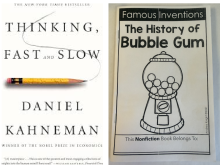
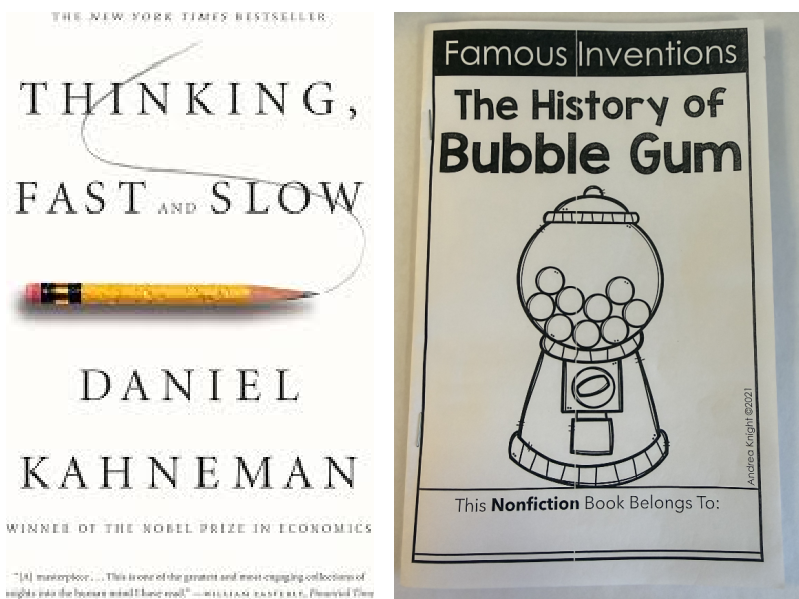
This month, I am sharing my thoughts on Daniel Kahneman’s Thinking, Fast and Slow, and Famous Inventions: The History of Bubble Gum by second graders in Mandy Lofquist’s collaboratory class.
Thinking, Fast and Slow by Daniel Kahneman
I began hearing about this book when it came out in 2011. I even had an unread copy that I gave away as I purged my shelves before moving from Houston to Fort Worth in 2015. I had started reading it before I gave my first copy away, but I had never been able to get past the first chapter or two. Part of the challenge was the subject matter: Kahneman knows his field so well and actually describes it with clear language and wonderful examples. It is just complicated stuff.
Over the last few months, I pushed all the way through the book, and I get why it is so highly acclaimed. It has many gem-like observations and thoughts on Big Picture issues in our lives, especially about how we make decisions. The basic concept is simple. Kahneman asserts that we have two systems of thinking: One is fast, and one is slow. Fast is intuitive. Slow is deliberate. Fast is automatic. Slow is controlled (13). Being aware of each system can help us make better decisions. Stopping to think which system is at play before we act on the information we are processing is important.
Citing decades of his own and other people’s research, from psychology to economics to the psychology of economics, Kahneman makes a reader nod their head a lot. I found myself thinking, “Oh yeah, I do that a lot.” While there are plenty of upsides to the book’s thoroughness, he sometimes refers to a previous example in the more than 400-page book, which made me go back to look it up. For me, then, the language and the style and the topic made Thinking Fast and Slow a difficult read with some valuable takeaways I just hope to retain.
Some examples of the good stuff:
I find myself asking, “Where at FWCD have we been subject to ‘availability bias’?” Our work on security and safety, for instance, needs to be continually checked against intuitive and deliberate thought.
Where am I prone to the Halo effect? Do I give the especially articulate person more credit for their perspective than I should, for example?
I find myself hoping that reading the book has made me a better decision-maker. We all have decisions to make, most every hour of every day. Some are more impactful on others, some on us. “[Decision-makers] will make better choices when they trust their critics to be sophisticated and fair, and when they expect their decision to be judged by how it was made, not only by how it turned out.” (418) (my emphasis)
Some favorite lines from Thinking, Fast and Slow include:
“So this is my aim for water cooler conversations: improve the ability to identify and understand errors of judgment and choice, in others and ourselves … .” (4)
“When faced with a difficult question, we often answer an easier one instead….” (12)
“[T]he premise of this book is that it is easier to recognize other people’s mistakes than our own.” (28)
“... [Y]ou are imagining the numerator – the tragic story you saw on the news – and not thinking about the denominator, which includes many safe cases.” (144)
“... [T]eaching psychology is mostly a waste of time.” (170)
Some of my favorite anecdotes and research results include:
Traffic-related deaths in Israel occur far more than terrorist related deaths. (144)
“Rational or not, fear is painful and debilitating, and policy makers must endeavor to protect the public from fear, not only from real dangers.” (144)
“Psychology should inform the design of risk policies that combine the experts’ knowledge with the public’s emotions and intuitions.” (145)
“Subjects’ unwillingness to deduce the particular from the general was matched only by their willingness to infer the general from the particular.” (Nisbett and Borgida) (174)
Picking stocks successfully is mostly an illusion. (212ff)
The “remembering self” is often wrong. (381)
“The central fact of our existence is that time is the ultimate finite resource, but the remembering self ignores that reality.” (409)
“One example [of work to be done improving decision making] is the remarkable absence of systematic training for the essential skill of conducting efficient meetings.” (418)
And I have “unfavorite” aspects of the book:
Every time Kahneman (or anyone else) uses the word “heuristics,” I am confused. I do not understand the word or its application. I find it distancing: It strikes me as a term certain practitioners or experts use in ways that exclude non-practitioners or experts. He defines it this way on page 98: “a simple procedure that helps find adequate, though often imperfect, answers to difficult questions.”
WYSIATI: He uses the abbreviation for this expression a lot. I found myself having to look it back up most every time he used it. It stands for “What You See Is All There Is.” I found this unhelpful.
Famous Inventions: The History of Bubble Gum by Second Graders in Mandy Lofquist's Collaboratory Class
I was very grateful to read our second graders’ insightful study, The History of Bubble Gum. My favorite quote might have been on page 5: “Experiments done by scientists have shown that chewing gum helps make people think better while working on hard tasks.”




.jpg "My First 40 Years: Snow Days, Then and Now")